
FEATURED| All GEO-POWER-EU Indices Now Live
|
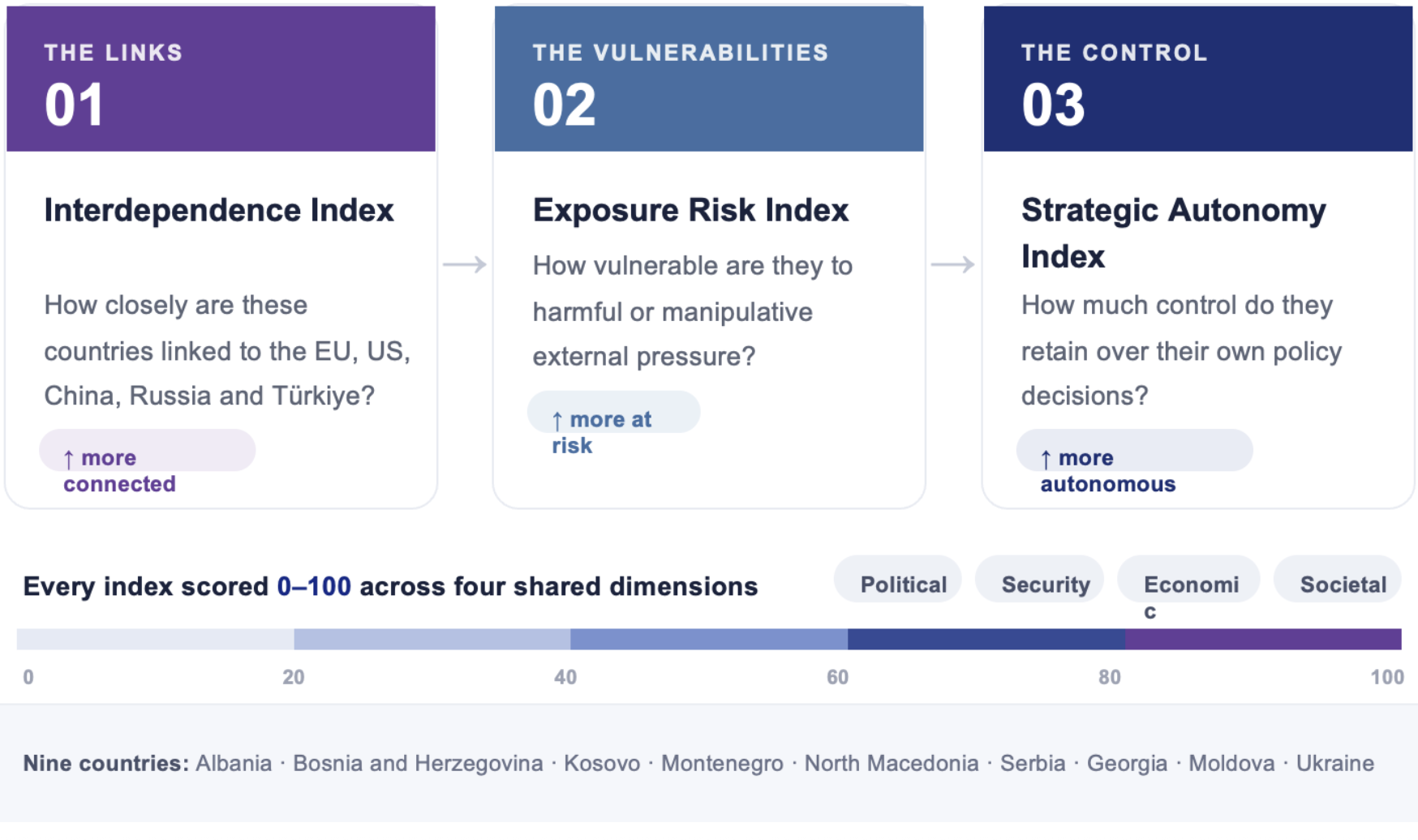
Following the launch of the Interdependence Index, GEO-POWER-EU has now expanded its suite of analytical tools with two new indices, both available on the GEO-POWER website. The newly released Exposure Risk Index measures how vulnerable countries in the Western Balkans and Eastern Partnership are to negative external pressure, while the Strategic Autonomy Index assesses their capacity to make independent foreign policy decisions. Together with the Interdependence Index—which maps the political, economic, security, and societal ties between nine countries and five major external actors (the EU, US, Russia, China, and Türkiye)—these three indices provide a comprehensive, data-driven framework for understanding geopolitical influence across the region.
New Research Reports |
This issue brings a substantial batch of new research outputs published in the past six months. These include country-level case studies examining how disinformation and corrosive capital operate on the ground across the Western Balkans and Eastern Partnership, tracing specific actors, mechanisms, and governance gaps — as well as a cross-regional sentiment analysis report and two policy reports on economic convergence and brain drain and on the green energy transition.
New publications now available:
🔷D 2.2 I Economic Convergence and Brain Drain in the Western Balkans and Eastern Partnership
🔷 D2.3 | Green Energy Transition
Case Studies
🔹Anti-European disinformation in Ukraine during the Euromaidan period and the full-scale war of Russia against Ukraine
🔹The Serbian Regime’s Fight Against the “Color Revolution”
🔹Milorad Dodik’s campaign targeting the European Union in Bosnia and Herzegovina
🔹The Vareš Mining Project in Bosnia and Herzegovina: A Case Study of Corrosive Capital in an Already Corroded Political Economy
🔹Corrosive Capital in Transport Hubs: The Chișinău Airport Concession
GEO-POWER-EU Holds 3rd Consortium and General Assembly Meeting in Chișinău |
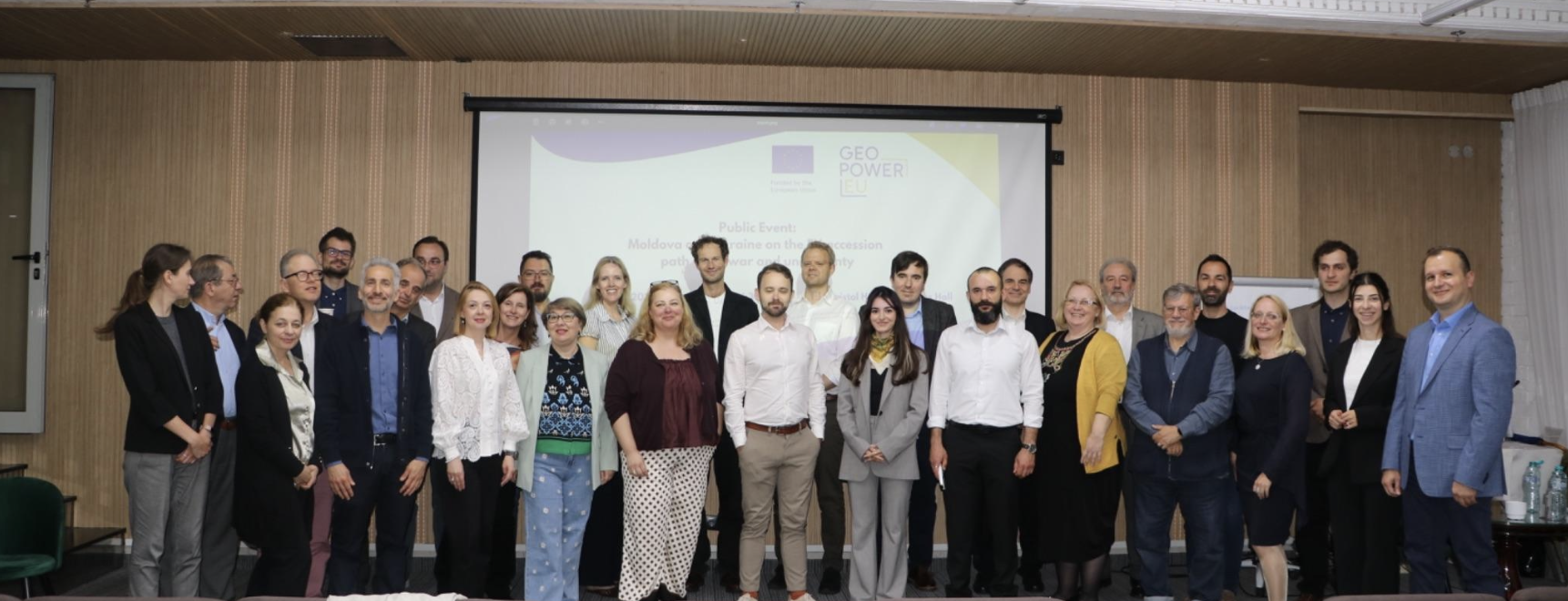
On 2–3 June 2026, the GEO-POWER-EU consortium convened its third in-person General Assembly in Chișinău, Moldova, hosted by project partner IDIS “Viitorul”. Taking place shortly after the European Commission’s successful mid-term evaluation of the project, the meeting saw partners review progress across all work packages, including EU enlargement research, geopolitical competition analysis, and strategic foresight workshops, marking a key milestone in the project’s second phase. A highlight was the strategic foresight workshop led by VE Insight, which brought partners together in four working groups to map geopolitical scenarios for the Western Balkans and Associated Trio through 2031 — examining the influence of the EU, US, China, Russia, and Türkiye.
Two New GEO-POWER Talks Episodes Are Out! |

The latest GEO-POWER-EU Talks Episode 6 & 7 focuses on foreign influence challenges in the Western Balkans and Associated Trio, with expert guests exploring how disinformation campaigns and corrosive capital operate in tandem to undermine democratic institutions and EU credibility across the region.
What GEO-POWER-EU Researchers Have Been Up To? |
GEO-POWER-EU researchers have remained active across academic, media, and policy arenas—bringing evidence-based insights into today’s most pressing geopolitical debates. GEO-POWER-EU partner the Democratization Policy Council (DPC) launched a new podcast series, DPC Voice, bringing evidence-based perspectives on democracy and governance in the Western Balkans and beyond. Asst. Prof. Tena Prelec (University of Rijeka) joined the Seriously Balkans podcast to discuss whether corrosive capital in the Balkans is increasingly Western, challenging the assumption that such investment flows mainly from authoritarian states and gave an interview to Hungarian daily Népszava on corrosive capital in the Western Balkans and Associated Trio, highlighting how opaque investment from multiple geopolitical actors undermines governance and accountability across the region. Assoc. Prof. Panagiota Manoli published a new op-ed arguing that the EU must solve the credibility deficit in its enlargement policy, moving beyond vague promises toward tangible accession steps. GEO-POWER-EU PI Prof. Nikolaos Tzifakis, together with Eleni Vasdoka, published a new article introducing the concept of “reversed conditionality” to explain how Western Balkan elites strategically leverage EU enlargement processes to consolidate domestic power.
What’s next? |
With the GEO-POWER-EU research phase reaching key milestones, the project is entering a new stage focused on collaboration and policy development. From September to December, the consortium will organise a series of co-creation studios, policy briefings, training sessions, scenario-testing exercises using the GEO-POWER-EU serious game, and expert roundtables across Europe. Bringing together researchers, policymakers, civil society, and regional experts, these activities will validate the project’s findings, explore future geopolitical scenarios, and translate the research into practical, evidence-based policy recommendations. Their outcomes will directly inform the project’s final policy framework for strengthening the EU’s engagement in the Western Balkans and Eastern Partnership.
Subscribe to our newsletter here and follow us on Twitter, BlueSky, LinkedIn, Facebook, and SoundCloud for updates!